| Nipper
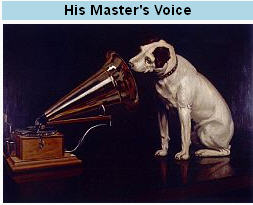
Nipper, a fox terrier, belonged to Mark Barraund and after
Mark’s death, his brother Francis Barraund noticed that the
dog listened intently to the voice of his dead master as it
came over the trumpet of the phonograph. Francis painted the
dog listening, and in 1899 the picture became the trademark
for The Gramophone Company Ltd.
Copyright
expired |
 |
|
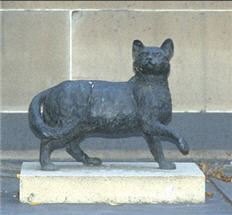
TO THE MEMORY OF
TRIM
The best and most illustrious of his race
The most affectionate of friends,
faithful of servants,
and best of creatures
He made the tour of the globe, and a voyage to Australia,
which he circumnavigated, and was ever the
delight and pleasure of his fellow voyagers
|
Trim
Trim, a black cat
with white paws and white mark on his breast and chin, was
born on board a ship in 1799. He fell overboard when only a
kitten but climbed back onto the ship. From then on, he
enjoyed swimming. Matthew Flinders owned this remarkable cat
that was to sail with him as he made the first
circumnavigation of Australia. Trim also circumnavigated the
world with his master. He was with Flinders when they were
wrecked on Wreck Reef and the crew had to spend some weeks
waiting there to be rescued. Trym was imprisoned with
Flinders on Mauritius by the French but disappeared.
Flinders was deeply saddened. The statue of Trim is in the
Mitchell Library in Sydney, NSW Australia. |
|
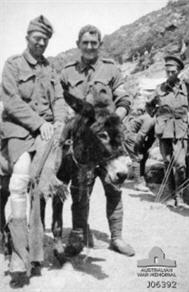
Simpson and his donkey
Simpson and his
donkey are famous in Australia for
their actions during World War 1. Simpson’s real name was
John Simpson Kirkpatrick, but as he had deserted from
the Royal Navy in 1910 and come to Australia, he enlisted in
the AIF as Simpson. On 25th April 1915,
Australian and New Zealand troops landed at Gallipoli in
Turkey, with great loss of life, at what has become known as
Anzac Cove. Simpson found a donkey and although he was
unarmed, he took wounded soldiers on the donkey from the
front line back to medical assistance. Day after day he did
this and became known for his bravery. The donkey was known
as Duffy and sometimes as Murphy. Sadly Simpson was killed
by Turkish gunfire four weeks later. He is remembered by
Australians on Anzac Day 25th April, each year.
|
 |
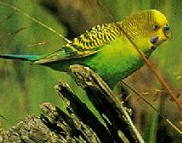
No photo of Sparkie is available, but
this is a similar bird. |
Sparkie
Sparkie was a a remarkable budgie who
is still remembered 50 years after his death in 1962.
He won a contest in 1958 for the BBC International Cage
Birds. He could say ten rhymes, 383 sentences and 531 words.
There were 3,000 birds in the competition from all over
Europe. He soon became famous on TV shows and made a fortune
for himself. He could repeat almost anything and was owned
by Mrs Mattie Williams and lived in Newcastle's Forest Hall.
Sparkie's preserved body was donated to Newcastle's
Hancock Museum. |
|
Phar Lap
Phar Lap was born
October 1926 in New Zealand and bought to Australia by
David Davis on the advice of race horse trainer Harry
Telford. From 51 starts, Phar Lap had 37 wins, three seconds
and two thirds. Telford and jockey Jim Pike, loved Phar Lap,
and said he could do anything except talk. The horse became
the darling of people all over Australia and when he was
sent to America to race and died 5th April 1932
soon after his arrival, there was outrage and suspicions
that he died of foul play. His body is on display in the
museum in Melbourne, Victoria, Australia.
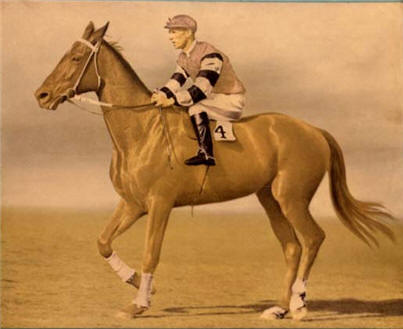
This photo comes with permission from the museum:
SH 870002, Picture - Phar Lap & Jim Pike,
Mounted, 1930s (SPORT), Image, Registered
|
 |
 |
Skippy
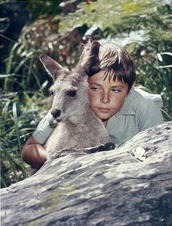
Skippy was a kangaroo that featured in an
Australian TV series for children named Skippy the
Bush Kangaroo. Ninety thirty minute episodes were
made and the series was shown in many countries, making
Skippy famous. The part of Skippy, an eastern grey kangaroo,
was played by a number of kangaroos and the tricks shown
were provided by technology rather than the animal itself.
The story was set in a National Park where Sonny Hammond
lived with his Ranger father, Matt. Skippy often came to the
rescue or discovered a plot to endanger other animals or
people.
|
|
|